EMPOWERMENT in 5 Minutes
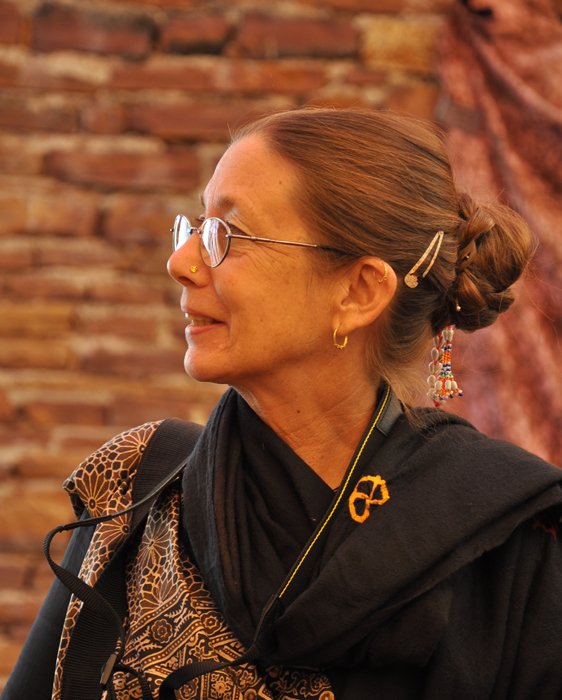 I recently received an award from Ojaswini for work in women’s empowerment. Simultaneously, I was interviewed on the same topic for Hand Eye. It got me thinking… we have come a long way for sure. But I guess we still have some way to travel.
As I was thinking of what to say in a five minute talk, two men in safari suits came into my office. They were from the power plant that is slowly but surely surrounding our little rural institute. As we talked, they proudly told me that the people of the village next door were so much better off now. They were all driving trucks (for the Company) and had cement homes and fans.
This is true, no doubt. But what he did not know is that the women of the village say that they can’t sleep at night because they are worrying about their future. (And, I might add, that the traditional village homes were so ecologically engineered that they did not need fans!)
Questions have driven my work over the past two decades, so I decided to begin with a question: Is money empowerment?
To me, empowerment is about realizing potential, about self esteem, being able to make choices, and about using creativity. What has kept me in Kutch for all this time was not only the amazing creativity of traditional artisans, but also the sense that the potential was not fully realized. And, maybe the will to be a catalyst. I believe in Gandhi’s deceptively simple concept: Recognize and capitalize on strengths.
Kutch traditional arts are world renowned. But, all of the artisans with whom we work are marginalized. They are dalits, minorities and women. Think about that– what does it say about how society perceives craft?
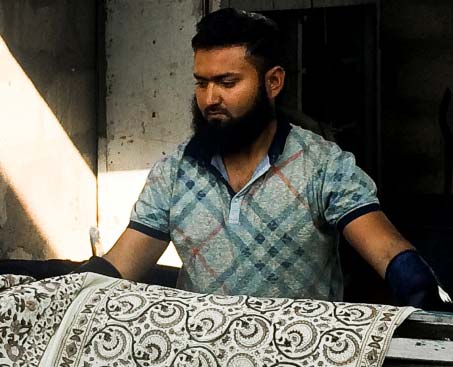
.Women’s arts in particular were never commercial. In the last three or so decades, due to economic duress, women started to work for wages. Simultaneously, embroidered embellishment came into fashion. This presented a good option: women could earn through embroidery while attending their homes. But most commercial ventures capitalized on the fact that women had few socially acceptable options to earn. Women earned, but usually at substandard wages.
Was earning empowering?
Earning builds confidence and expands capacity. Women do become stronger when they are earning. They become more able to think of themselves, to dream and fulfill those dreams… But all too often they continue to think of themselves as laborers. They feel small, powerless and always beholden.
In 1993, one such artisan asked me: Why are you studying us? Why don’t you help us? She wanted better wages and more say in what she did. Thus, together, we established Kala Raksha to address these issues.
We began by simply paying fair wages- determined by the artisans themselves- and providing women with steady work. We began with 25 artisans and RS 43,000. By 1996, we held our first solo exhibition in Delhi, where we received an unprecedented response: RS 5 lakhs in 4 days! Last year, with 1,000 artisan members, we turned over more than 1 crore.
So, here comes that question: Is money empowering?
Surely. But, we soon realized that empowerment REQUIRES MORE THAN MONEY. Kala Raksha began to look at deeper issues: What about cultural empowerment?
We saw that the conventional practice of “design intervention”- professional designers giving artisans their own designs to fill up, can easily dis-empower artisans. Artisans were confident in making their own traditional work, but when someone perceived as powerful came and told them to do it their way, they begin to feel that their own work was “not good.” And that they needed someone to tell them what to do. They give up their active creativity– their most valuable asset. (Who designed those traditional pieces that draw people to work with them, anyway?)
So, in 1996 we established a museum in Sumrasar village, and actively used it to engage artisans to design by innovating on their traditions.
Kala Raksha built a name that is internationally known. Women participated in all aspects of their income generation, from design to pricing to marketing.
YET, we still wondered, are women artisans empowered? Is their potential realized?
Then we realized that the economic and cultural issues were connected:
In most craft projects, the model used for production is the industrial model. The goal is faster, cheaper and more standardized–what machines do. This industrial model is good for the customer but disastrous for the artisan. When the hand tries to compete with a machine, it will fail.
So we have to create an alternative model that capitalizes on the human quality of the hand. The real challenge is to change the perceived value of traditional art.
ULTIMATELY, THE SOLUTION IS EDUCATION
And so in 2005, we began KALA RAKSHA VIDHYALAYA
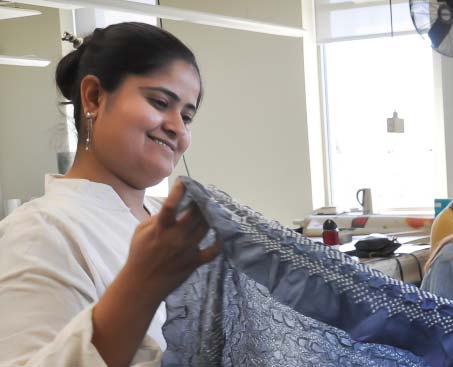
In the Vidhyalaya’s year-long design education program, artisans learn to utilize design to innovate on their traditions for contemporary markets. They learn to make decisions creatively, and to be responsible. They experience success. To emphasize the value of creative input, last year we founded the brand Artisan Design, and women finally began earning at better (though still modest) rates.
After the second class graduated, we went to Delhi to participate in a seminar at UNDP. We sat around a table with top international water experts. When we introduced ourselves, one graduate, aged 21, said, “My name is Bhagvatiben, I am from Sumrasar village, and I am a designer.”
That’s when I knew we were on the way to empowerment.