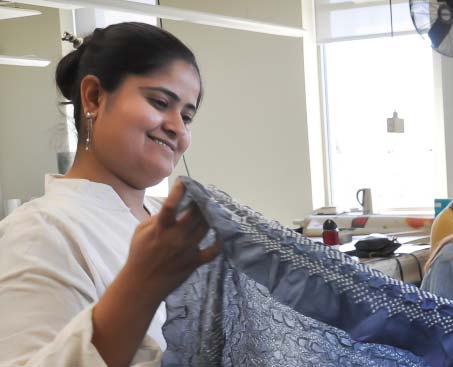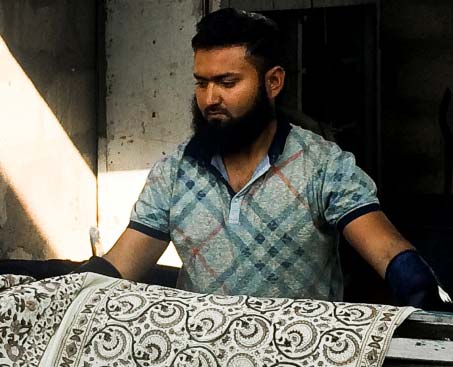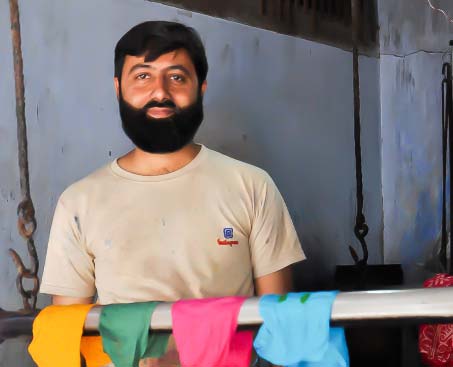
 I had concluded through research and filming interviews with artisans in Kutch that men and women artisans have different relationships to creativity. For women, creativity is an intrinsic part of craft. They would never dream of copying. Why? When you could instead create something new and enjoy the process.
“I made 9 embroidered kanchali,” Harkubhen recalled. “And each one was different!”
Why?
Incredulous, she answered, “Because it looked good! Otherwise, people would say, ‘she only knows one thing.’”
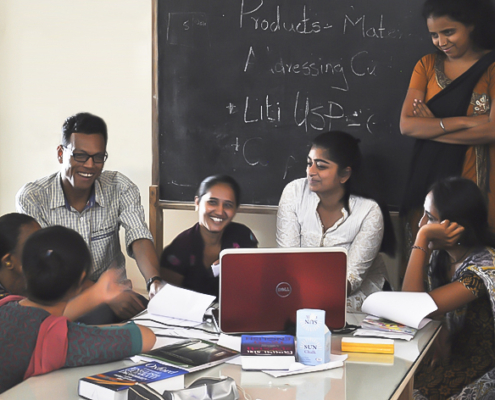
I was pleasantly startled when we began to work with embroiderers of Lucknow. They were equally clear on the difference between inspiration and copying. And they were not interested in copying. “I don’t want to work on printed patterns,” Monisha said, unquestionably. “It is a waste of time that I could use creatively.”
“I want to work from my imagination,” Kushboo passionately stated.
Is this view of creativity embedded in the XX chromosome?
Needs further research.
To me, creativity is closely related to the concept of the Greater Good, something I have been thinking about for some time. The Greater Good is a global perspective.
If we see the world as one big whole, as shared resources and interconnected actions, our values and priorities change. It’s why I turn off the lights, even when it’s not me paying the bills. It’s why I planted trees at a rented house.
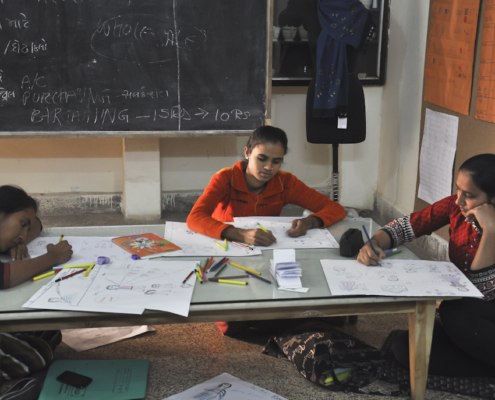
And it is why I thought of creating a design school for artisans. Because it was needed and had not been done. For years I would mutter, “They should start a design school for artisans.” It took an earthquake for me to realize there was no ‘they.’ When a reporter asked me in the freezing cold of a January morning what I would like to see come out of the earthquake, I said, “A design school for artisans.” And so I had to take it on.
I received an Ashoka Fellowship to develop the curriculum. A key goal of that design education curriculum was to increase diversity and decrease dependence. Finding and following one’s unique identity automatically results in diversity. There is no duplication in nature. What an amazing concept! It must lead to a deep respect for diversity. In the 136 artisans I have nurtured over nine years, I did not see any duplication. None. And what I learned is the wonderful secret that if there are 136 different styles, it multiplies the potential for 136 artisans to successfully survive in the equally diverse market! We educate artisans so that they can develop their individual niches in the market rather than depend on us to sustain them (or vice versa!)
I initially thought that design and entrepreneurship were for everyone. I now realize that not everyone can be an artist. No everyone wants to be. But those who have the imagination, talent and desire should have the opportunity to reach their potential.
Somaiya Kala Vidya is working with these individual artists, guiding them to scale out.
Taking a global perspective, we can avoid duplication of effort- and creating unnecessary competition. If we see the world as a whole, we can choose to work where work is needed. Respect for diversity and global perspective means understanding that there is a lot of work to be done. If one need is being met adequately, it makes better sense to support it, and think what ELSE needs to be done.
Duplication is wasteful in many ways, including wasteful of spiritual energy.
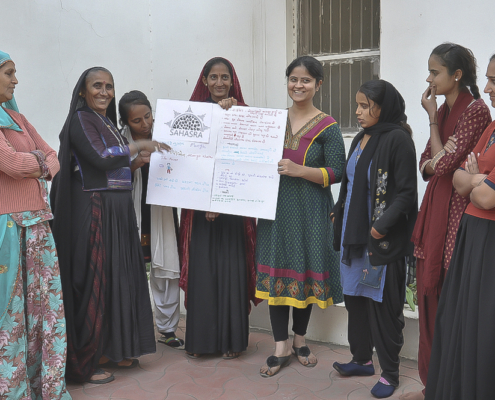 As women artisans have quietly demonstrated, repitition is the antithesis of creativity, and the limitation of diversity. We can learn the simple way of creativity from them. If Varsha ben did something nice- good. I will do something else. Monghiben is doing that? Good. I will do this. This way, a tradition grows, organically, applying creative capacity for the Greater Good.