The Unbearable Cuteness of Commercialization
Some time ago, I sent my friend the film, The Laya Project, which is about music of the seaside cultures affected by the Tsunami of 2004. The film, with tracks mostly remixed by one of India’s best known composers, is beautiful and as my friend is a musician, I thought he would enjoy the music of these varied lands.
Here is what he wrote when he received the film:
hi Judy,
Thanks so much for the lovely Laya Project package. I watched the DVD today, and I scanned through some parts, so I may have missed something, but I have to tell you, as lovely and award winning and everything as it is, nonetheless, to my taste or sense of the rightness of things, the music is like playing beethoven with an electric bass, a backbeat, and maybe jazz scatt singing or something or fusing beethoven with lawrence welk. So, even while I find myself moving to the beat and some of the playing and singing is beautiful, I simply am horrified by the destruction of culture…..
It brings to mind what you are working on….the preserving of traditions in the face of the onslaught of western culture. I will think about this awhile, and watch the movie again. My main ‘question’ at the moment, is what is essential in traditional culture, that one in fact even wants to preserve and transmit? I think if you turn the music into second rate (if beautiful) western pop music…..that can’t be preserving what is essential,
Maybe what is essential is the actual preservation and continuation of playing and singing, and not the seemingly essential if to some degree intangible quality of the content?
At first I was surprised, but quickly I realized that Paul has an ear for music because he is a musician, and since I am not I had just listened to the catchy cute tunes. Music is Paul’s subject, as the artisans we work with say, and traditional textile art of Kutch is mine.
We began Kala Raksha thinking on the issue of preserving the essential—our organization was to be an alternative to cutified and industrialized craft. When we observed people “Giving Designs” to artisans, it seemed a travesty. The “re-mixing” of traditional forms, printing them on a cloth and giving them back to the people whose cultural property they are is like the high school photographer who airbrushed my Afro hairdo into a bouffant for the 1969 year book.
Making artisans work on printed, perfected versions of their own art is like giving Picasso a colouring book, or like tying cows instead of letting them roam. One artisan recently depicted her feelings about the two 4,000 MW coal fed thermal power plants that now surround Kala Raksha Vidhyalaya, our rural design school. She showed a cow in scene one, and a tied up cow in the last scene. That said it all
Where is the art? And where is the artisan?
I passed this discussion to my friend Jaya, who had introduced me to the Laya Project. She wrote:
mohan and i often talk about the relative merits and demerits of innovating/ improvising and maintaining purity/ discipline – esp of classical arts.
i feel it is up to individual aptitudes and inclinations – and both should have their place. being a diehard purist, i am always drawn to all arts in their most basic forms and i am sure that some people always will practice and patronise them thus – but one of the most significant outcomes of maintaining the sanctity of the pure forms is that they serve as the fountainheads for the ‘other’ kind of people to take inspiration from. and i think in both categories, there will be people who will fail – by being too hidebound in their attachment to maintaining purity and being too shallow in their efforts to improvise.
it does feel like as time is going by, the purists are around less and less, but maybe that’s how it feels in all ages. and for folk art forms that are so tightly tied to traditions of living, the challenge is so much greater.
Kala Raksha’s concept of preservation of tradition was based on the belief that if artisans are creating their own work it will retain integrity. Over the years, I have realized that even that is too simple. More insidious forces are at work. I think that Power changing the perception of aesthetics is the destroyer of tradition. Traditions change or they die, but what influences the change matters. The original folk art was made to satisfy the artisan’s aesthetic sense, and for the sheer joy of creativity. It changed organically as lifestyles changed and people borrowed new concepts and materials that attracted them. Commercial work is usually given ready made from an outside source, and cranked out like factory products, for money. But since it sells, and money is power, it is seen as “better.” When artisans’ own sense of aesthetics are weakened or warped, that is the real endangering of tradition.
In the first year of our design school for artisans, we took the students to the Calico Museum of textiles. I asked one market savvy weaver what he thought?
“It was ok,” he said.
OK???? The premier collection of Indian textiles in the world?
“Well,” he explained, “The embroideries were not all that fine.”
He had been influenced by the perfected, commercialization of embroidery to think that the smaller the stitch the better the embroidery. But what he had seen were the originals!
Last week we went to Ludiya village and I was horrified to see that the Meghval artisans had purchased very large piles of old Rabari embroidery. They had also hired a tailor, and he was cavalierly cutting the beautiful original pieces of art into bits and stitching them into cheap patchwork wall hangings. I felt like I was in a slaughter house. .Many times dealers over-dye these “wall hangings” in orange or black. In my opinion they are worse than cute. But on two separate occasions I have been equally taken aback to see that tourists actually like them and even prefer them to the original old embroideries. The village artisans-turned-dealers have figured this out, and it is so much easier and more lucrative to cut and paste than to embroider.
Further on, heading into the Black Hills of Kutch, we saw the roads littered with commercial signage for increasingly commercial events and places. Designer huts with women wearing designer village clothes, beckoned us to stay in their hotel. When we reached the top of the hill, our view of the vast Rann of Kutch was marred by huge and ugly cut outs of the Great Indian Bustard and the Desert Courser.
The grand finale was that the jackals who have come to eat prasad every sunset for countless generations just did not show up, in spite of one local tourist bellowing for them to COME! So maybe the cardboard cutouts will be the only jackals we see at Kalo Dungar.
And maybe commercialized embroidery- remixed in one way or another- will be the only embroidery.
It seemed like the sun was setting on a lot.
It’s not that I think people should stay as they are. Traditions have to change to live. When we began our Vidhyalaya, I was once told to “leave craft alone.” It’s already too late for that. When most “craftspeople” are really labourers, filling in someone’s colouring book, or dealers refurbishing the original work of more isolated and poorer artisans, craft is already not left alone.
The answers we have are education and exposure– enabling those concerned to be the decision makers and giving them skills and knowledge to make intelligent solutions.
Maybe if the Laya musicians could have made the music they wanted, given some knowledge of who it was for, it might have been different. Not so cleaned up and cute. We hope to raise consciousness so that artisans appreciate their own traditions for what they are– the essential, intangible quality, as Paul said. And finally to encourage artisans to be the active creators of their art. That is what Kala Raksha stands for.
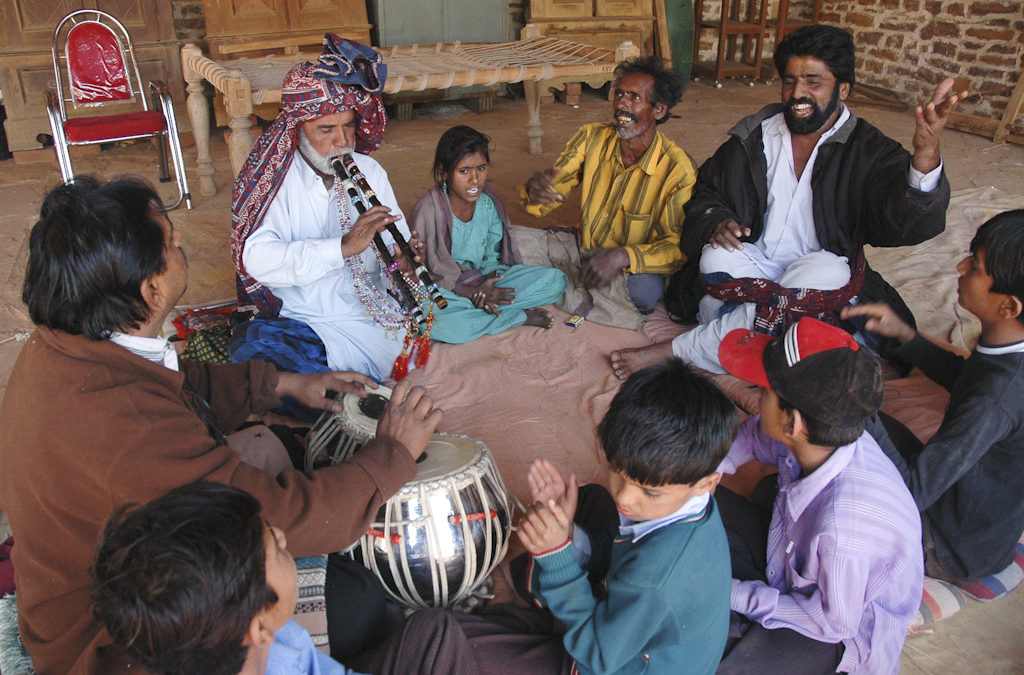
Now we also need to value integrity and creative expression. To raise awareness, we have launched the concept Artisan Design. We need to connect with a few people who want to see the jackal rather than a cardboard cut out, to hear artisans playing music from the heart, and of course to patronize embroidery with life force. Last night, I saw a glimmer of hope with musicians we had invited for a touristic performance. The performance was predictably staid and the guests were nodding off—BUT when the musicians were jamming informally in a storage hut, playing for their own love of music, they drew people like pied pipers til the little hut overflowed.
I KNOW YOU’RE OUT THERE!