Who Are the Workers? the Artisans’ View

Some time ago I wrote a blog post about my concern over where craft was going. My concern arises from the low status given to those who work with their hands. Craft seems to be perceived as an antiquated, inferior form of manufacturing that could only survive if “helped,” and artisans are perceived as skilled laborers.
Traditional craft in India was not made in in large scale factories or production lines. In Kutch, an individual or family conceived the object to be made, produced or procured the raw materials needed, and created it; it was holistic creation. The artisan knew the user, and delivered his work to him directly. Each artisan family had its own clientele, and there were often hereditary, personal relationships between makers and users. As I have understood it, traditionally craft was made in a community-based horizontal social structure, in which artisans all held more or less equal economic and social status.
Craft was traditionally exchanged in a barter system. Weavers, printers and dyers gave fabrics to herders and farmers, and in turn received milk, goats and grain. When asked how they insured that goods exchanged were equal in value, Irfanbhai said simply, “We didn’t.” People received what they needed when they needed it. The shift in conception between this traditional valuation system and the commercial market is enormous.
My concern is that when craft is pushed into the world of not only cash economy but also industrialized scaled-up production, the structure of artisan societies changes from horizontal to vertical. Economically stronger individuals become “Master Artisans,” employ previously equal status artisans as workers, and gain higher social as well as economic status.
Not only that; they stop making.
Many of the artisan students at Somaiya Kala Vidya have been job workers for bigger players in the craft world, and want to learn design as a way to begin to become independent. As they grow, they will no longer be able to fulfill their own orders. So who will work for them?
I sincerely hope- I wrote- that our design and business education programs are not simply producing more “Master Artisans.” As businesses grow, artisan designers seem to get farther from being artisans.
I offered a suggestion for an alternative.
But I am not an artisan. My friend Albert, who has worked many years in the craft world, says, “The artisans have all the answers.” And after all, it is their life.
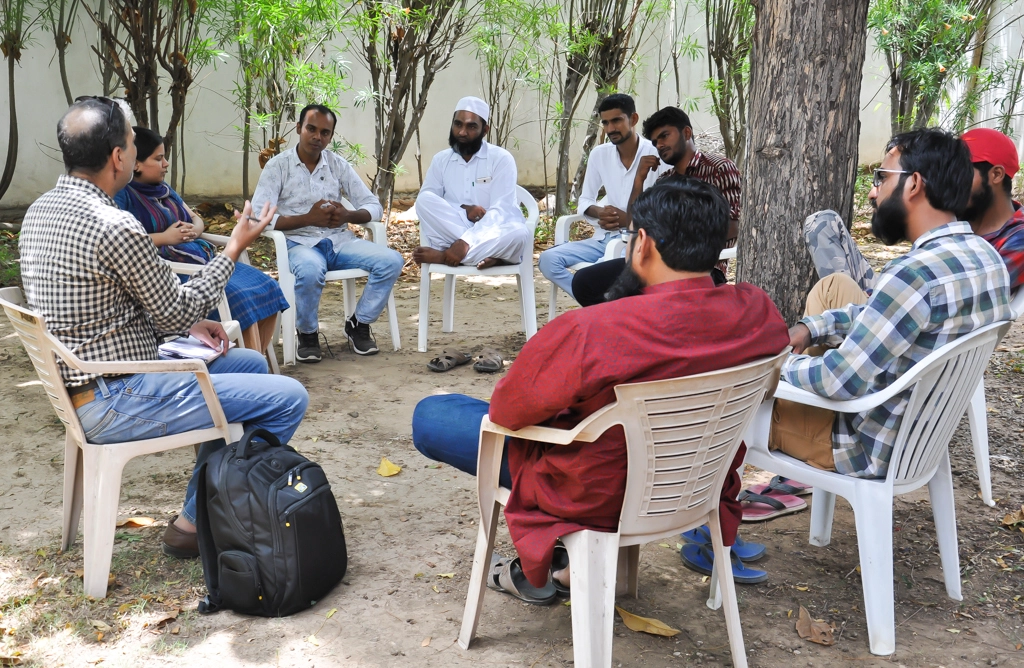
So we gathered together a group of design graduates, and a facilitator, a dramatist Sanjaybhai to explore….
After I introduce the issue, there is the usual silence.
Finally, Juned I says, “Actually there is not such a big problem as you imagine.”
Khalidbhai gives his view. “Actually, there is an easy solution,” he says. “We have to teach people. We teach them, and they grow. When they want to have their own business, we teach new people. There are so many people in nearby villages who want work.”
Sanjaybhai asks, do you do this out of necessity? Or do it as a policy?
Slowly, more comes out. There are two situations: one where a worker wants to set up his own workshop, and one where he moves to another workshop. Juned H. says that it’s only the Khatris- traditional dyers- who want to start their own businesses. For one thing, they don’t teach the other workers everything.
For other workers, the group agrees, it’s good to keep them with you. But there are employers with less than ethical practice. Suppose Junedbhai has a well-trained worker, Khalidbhai says. I can offer him more money and he will come to me. That IS a problem.
What happens then?
Nothing, they say. It happens. Workers have to fill their stomachs, after all. And some come back. It’s a floating population.
But what does that do to relationships? I ask.
Juned H says, “Look, this is the law of nature. It’s like a food chain.”
Sanjaybhai says this is the situation with domestic workers too. So many people have offered his maid more money. But she has stayed with him for many years. Why? He supports her in other ways, educating her children, offering medical assistance, loans when she needs them, etc.
They all respond to this. Yes, of course, it is important to treat workers well. Family-like relations with your workers brings loyalty. They all have some good examples.
After more discussion they conclude that there are people who will always be lured by money. And there are people who will always try to lure them. That is the way of the world.
I say familial relations was more like the traditional model, wasn’t it?
Traditionally we taught by the stick, they say– for family members as well as workers. If you did not work well, you got hit.
Mukhtarbhai, a bandhani artisan, agrees. With bandhani, if you were using the wrong posture, you used to get smacked. It was for their own good, so that in the future they would not suffer. All of the group chimes in with their examples- even Sanjaybhai! Most of them were taught this way only. And they feel it is good. Tough love. That’s family.
I ask what about satisfaction- other than money? While working, don’t people think, what if I make my own design, start my own work? Mustakbhai, for example, used to be a job worker. What made him want to study design?
Mustakbhai agrees. People want something more.
But then they all agree that once you are set you don’t have to do your own work.
I ask how many of the group are doing their own work now?
Prakashbhai, Mukhtarbhai, Mustakhai, Juned H. Not Khalidvhai, not Juned I., not Mubeenbhai. Just over 50%.
I’m surprised. Don’t you want to do your own work, sometimes? I ask. This was my objective of the design program for artisans.
The master artisan must know his craft, Khalidbhai insists. Otherwise he won’t get good work. But you can’t stay in one place; you have to move around, keep your eye on everything. Juned H. relates that in a workshop in his village he saw bad work being done. He asked the workers why they were doing bad work? The owner doesn’t know the difference, was their answer.
You have to learn your craft well, and you have to do sampling at least, they say. We do our own dyeing, they affirm. Mukhtarbhai describes the situation in bandhani. The women are independent contractors. They give work to the women tiers, but they always do their own dyeing. They consider dyeing the real art.
Maintaining respect for their traditions is very important, they all agree.
Prakashbhai has a different view; weaving is different, he asserts. We do it ourselves. We don’t train other workers because it is our tradition. It is technically more difficult, as well. So we work within our limits. We don’t have bigger production. “I had a client who said she would bring workers from UP for me so that I could do bigger volume,” he recalls. “I refused. We don’t want that kind of factory set up. Ours is a family craft. All members of the family are involved. If we outsource it won’t be craft. At least we keep the work in the community.”
All of these people have known only commercial craft. I too came on the scene after commercialization. I’m starting to wonder… Did craft always, even from traditional times, have workers? And will it always? But was there always hierarchy?
Mubeenbhai, Mr. Practical, wants to know when they are going to get started on the play? What is next?
Sanjaybhai says he works backwards. “At the end of the performance,” he asks, “what would you like the audience (mostly artisans) to think about?”
They should see teaching as part of their work, they say; they should see craft as a cycle. They should behave ethically and maintain respect for their craft traditions.
This is a play within a play, because it is about the artisans themselves.
At the end of our workshop, I hope the artisans who attended are all thinking about the future of their craft. Because they ultimately will create the solutions, and their future.